PDF READ FREE A Big Little Life
[PDF] DOWNLOAD READ A Big Little Life Online eBook
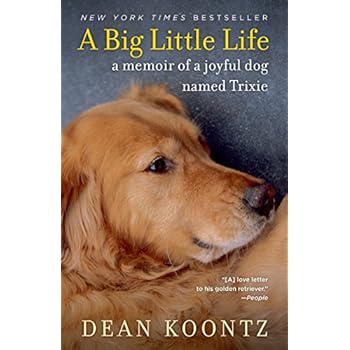
Description of A Big Little Life
Amazon.com Review Guest Reviewer: Ted Kerasote on Dean Koontz�s A Big Little Life Ted Kerasote is the author of several books, including Out There, which won the National Outdoor Book Award; the national bestseller Merle�s Door: Lessons from a Freethinking Dog; and Pukka: The Pup After Merle. Anyone who has read Dean Koontz�s novels (my favorite is Watchers) knows that he can tell a gripping tale while being perceptive about dogs, an insight made more noteworthy by the fact that Koontz didn�t have a dog for the longest time. Finally in 1998 he and his wife Gerda corrected this omission by adopting Trixie, a Golden Retriever and trained assistance dog, who had been forced by elbow problems to retire in her third year of service. It was the happiest forced retirement imaginable--for Trixie, for the Koontzes, and for all of us who are now privileged to read Dean Koontz�s loving memoir of this remarkable being: A Big Little Life. Like all great writers, Koontz has the ability to transform the ordinary--his daily life with Trixie--into the funny, the moving, and the sublime. Trixie�s accidentally gashing him while they play fetch turns into one of the great set pieces of medical comedy as Koontz ends up in the emergency room with a lacerated hand. On another occasion Trixie�s saying �baw� for �ball�--straining to say it, but saying it nonetheless--becomes a memorable recounting of all of our attempts to communicate with beings from another species. And Koontz�s simply watching Trixie move, her lithe golden body shimmering and flashing in the sun, takes on the quality of the divine as he expresses what so many of us have subconsciously thought about our own dogs: �The more I watched her, the more she seemed to be an embodiment of that greatest of all graces we now and then glimpse, from which we intuitively infer the hand of God.� It is no exaggeration to say that Trixie was the hand of God for Koontz. He recounts his difficult childhood, his dysfunctional father, and the many challenges that he had to overcome on the road to becoming a world-famous novelist. But with that fame came commercial caution: telling stories in the same old familiar way and a consequent dulling of his creativity. Then came Trixie. With �baws� and balls, with warning him of fires and intruders in the house, with humor, with stoicism, and with unflinching love, she restored his diminished sense of wonder and impelled him toward taking new risks with narratives, themes, and characters, the very ones millions of us now enjoy. �Some dog, huh?� he says. �Some dog, yes,� we must agree, also concurring when he adds, �The only significant measure of your life is the positive effect you have on others.� For all of us who have had our lives made better by our dogs, or for that matter by any loving being, A Big Little Life is a welcome reminder of the power of love to turn our hearts into mirrors, reflecting compassion back into the universe--as Trixie most surely did for Koontz and Koontz now does for us. Read more Review �[A] love letter to his golden retriever.��People�Read this book to be entertained, uplifted and deeply moved.��The Bark��A humorous, poignant portrait of [a] remarkable dog.��Kirkus Reviews��One dog book that everyone . . . will deeply enjoy.��Booklist (starred review) ��A delightful read. . . an unusually effective brief for the joy that dogs bring us.��The American Spectator��A tender, insightful, loving homage . . . an inspirational book of love, hope and humor.��Bookreporter.com Read more About the Author Dean Koontz, the author of many #1�New York Times�bestsellers, lives in Southern California with his wife, Gerda, their golden retriever, Elsa, and the enduring spirit of their goldens, Trixie and Anna. Read more Excerpt. � Reprinted by permission. All rights reserved. I a spooky moment around which the entire story revolves � THE SPOOKY MOMENT central to this story comes on an evening more than ten years ago. � Trixie, a three-year-old golden retriever of singular beauty and splendid form, adopted the previous September, is in her fourth month with my wife, Gerda, and me. � She is joyful, affectionate, comical, intelligent, remarkably well behaved. She is also more self-possessed and dignified than I had ever realized a dog could be. � Already and unexpectedly, she has changed me as a person and as a writer. I am only beginning to understand the nature of those changes and where they will lead me. � January 1999: Our first house in Newport Beach, in the neighborhood known as Harbor Ridge, had an exceptionally long upstairs hallway, actually a gallery open to the foyer below. Because this hall was carpeted and thus provided good traction for paws and because nothing breakable stood along its walls, I often played there with Trixie on days when the weather turned foul and on cool winter evenings when the sun set early. � Initially, I tossed a ball and sometimes a Kong toy down the hall. The Kong was about six inches long, made of hard rubber with an inch-wide hole through the middle. You could stuff a mixture of peanut butter and kibble in the hole, to keep your dog occupied for an hour or longer. I tried this twice, but Trixie managed to extract the tasty mixture from the Kong in five minutes, which was less time than I took to prepare it. � One evening the rubber Kong bounced wildly and smashed into a small oil painting, splitting the canvas. The painting was very old, and it was one of Gerda�s favorites. � When she noticed the damage a few days later, I fessed up at once: �The dog did it.� � �Even standing on her hind feet,� Gerda said, �the dog isn�t tall enough to do it.� � Confident that my logic was unassailable, I said, �The dog was here in the hall when the damage occurred. The Kong toy was here. The Kong belongs to the dog. The dog wanted to play. If the dog wasn�t so cute, I wouldn�t have wanted to play with her. Hall, dog, Kong, cute, play�the damage to the painting was inevitable.� � �So you�re saying the dog is responsible because she�s cute.� � I refused to allow my well-reasoned position to be nitpicked. I resorted to my backup explanation: �Besides, maybe she isn�t tall enough, but she knows where we keep the stepstool.� � So, because the dog had damaged the painting, in subsequent play sessions in the hall, we could not use the rubber Kong. Furthermore, I would not throw the tennis ball anymore, but would only roll it. � I explained the new rules to Trixie, whose expression was somber. �This is a valuable teaching moment,� I concluded. �You see, I�m sure, that if you had gone to your mother immediately after you damaged the painting and had taken responsibility, you would not now have this blemish on your reputation.� � Following the new rules, I always released the tennis ball with a snap of the wrist that gave it the velocity to roll the length of the hall. Trixie thundered after the ball, either snaring it near the end of its journey or snatching it out of the air if it ricocheted off the leg of a console and took flight. She returned it to me with dispatch, and at once I fired it off again. After twenty minutes, her flanks heaved, her tongue lolled, and though she still considered the tennis ball to be a priceless treasure, she was prepared to entrust it to me for a while. � Lying on the floor, facing each other, Trixie panted and I stroked her luxurious golden coat as she caught her breath. � From the week she came into our lives, Trixie and I had spent some time most days lying on the floor together. I found it relaxing for the obvious reason that a cuddle with a loving dog is always calming. I also found it strange, because she would stare into my eyes as long as I wanted to meet hers�ten minutes, twenty, thirty�and she would rarely be the first to look away. � These sessions were meditation but also communication, though I can�t explain what she communicated other than love. I can say that I frequently saw in her eyes a yearning to make herself understood in a complex way that only speech could facilitate. � Staring into Trixie�s eyes, I was sometimes silent but at other times talked to her about my day, my problems, my hopes, whatever came into my head. Those who love dogs know well this kind of rap. The dog does not react�and is not expected to react�to any of this, but listens and wonders. Dogs swim through a sea of human speech, listening attentively for words they recognize, patiently striving to interpret what we say, although most of it is and always will be incomprehensible to them. No human being would have such patience. Counting the many commands she had been taught when in training to be an assistance dog and all that she had learned on her own�cookie, chicken, walk, duck, stepstool, oil, painting, restoration, electromagnetism�her vocabulary was at least a hundred words. It would more than double over the years. This got me thinking.� The recognition that words have meaning, the desire to remember them, the intention to act on those that are understood�does all of this lead to the conclusion that the dog also yearns to speak? � On that January night, because Trixie had been an undiluted joy during the previous four months and had already been a force for positive change in me, I said, �You�re not just a dog. You can�t fool me. I know what you really are.� � As if in response, she raised her head, eased back slightly, and regarded me with what might have been concern. Golden retrievers have versatile brow muscles that allow them a wide range of facial expressions. She never before responded to me in this fashion, and I was amused to interpret her look as meaning, Uh-oh, somehow I�ve blown my cover. � �You�re really an angel,� I continued. � To my surprise, she scrambled to her feet as if in alarm, ran down the hall, turned, and stared back at me. Muscles tensed, legs spread for maximum balance, head lifted, ears raised as much as a golden can raise them, she seemed to be waiting for what I might say next. � I�m seldom speechless. Trixie�s behavior, which seemed to be a reaction to my words, as if she understood every one of them, raised the fine hairs on the nape of my neck and left me mute. � Intrigued, I got to my knees, wondering what she would do next, but she continued to watch me intently when I rose to my feet. � For a minute or two we studied each other from a distance of twenty feet, as though we both expected something of consequence to happen. Her tail did not wag. It wasn�t lowered as it would have been if she had been the least fearful. It was a perfect plume, as still as if she had stepped outside of time, where nothing could move her or even one hair upon her, nothing except her own will. � �Trixie?� I finally asked, and when I spoke, she retreated another ten or fifteen feet and turned again to face me in the same expectant stance as before. � This was not a dog who wanted solitude or even distance. The closer she could be to us, the happier she appeared. When I was writing, she would sometimes slink under my desk and curl herself into the shape of an ottoman, and she sighed with pleasure when I rested my stockinged feet on her. With Gerda even more than with me, this sixty-plus-pound creature behaved like a lapdog, most content when embraced. � This was the first and last time she wanted distance from me. As we stared at each other, I began to realize that regardless of what Trixie�s behavior implied, if it implied anything at all, I should not pursue this matter further if only because it disturbed her. Besides, I was dealing here with the ineffable, the pursuit of which offers endless frustration but no reward other than the thrill of the chase. � I sat on the hallway floor, my back to the wall, legs straight in front of me, and I closed my eyes. The nape of my neck tingled for a while, but when the fine hairs stopped quivering, Trixie returned to me. She snuggled against my side. Putting her head in my lap, she allowed me to rub gently behind her ears and stroke her face. � Later, I told Gerda about the incident, but of course she could make no more of it than I could. We don�t have paranormal experiences or go to psychics. We don�t even read our daily horoscopes. � I write fiction for a living. I could spin a score of intriguing scenarios out of this one spooky moment with Trixie, but none would be as strange as the truth, if it could be known in this instance. Truth is always stranger than fiction. We craft fiction to match our sense of how things ought to be, but truth cannot be crafted. Truth is, and truth has a way of astonishing us to our knees, reminding us that the universe does not exist to fulfill our expectations. Read more
Books are everywhere. Libraries big and small and bookstores are splattered all over college campuses and larger cities. They are all filled with one of the most important things of all time—books. Those who read books appreciate the multiple places to find books. Those who aren’t fans of books, don’t understand what could make readers want to obsess over books. There is a reason for their obsession, though. You hear it all the time: read every day.Reading is important because it develops our thoughts, gives us endless knowledge and lessons to read while keeping our minds active. Reading books to help us learn and understand and makes us smarter, not to mention the knowledge, vocabulary and thinking skills we develop.In the world today where information are abundant, reading books is one of the best ways to be informed. Though reading might seem like simple fun, it can be helping your body and mind without you even realising what is happening. What makes reading so important? It can be for these reasons and not just knowledge.For those who don’t enjoy it, you might change your mind after hearing about the benefits. Can something so easy and fun be so helpful in your life? Of course, it can! Reading can be a great benefit to you in many different ways—such as sharpening your mind, imagination, and writing skills. With so many advantages, it should be an everyday occurrence to read at least a little something.Books can hold and keep all kinds of information, stories, thoughts and feelings unlike anything else in this world. Can words, paragraphs, and fictional worlds be all that great for you and your health? It definitely can, and it is a timeless form of entertainment and information
Step-By Step To Download A Big Little Life
- Click The Button "DOWNLOAD" Or "READ ONLINE"
- Sign UP registration to access & UNLIMITED BOOKS
- DOWNLOAD as many books as you like (personal use)
- CANCEL the membership at ANY TIME if not satisfied
- Join Over 80.000 & Happy Readers.
OR

No comments :
Post a Comment